
ERCOT Dropped a Forecast That Should Change How You Think About Home Energy
What the new long-term load forecast means for Texas homeowners—and why distributed energy has never mattered more.
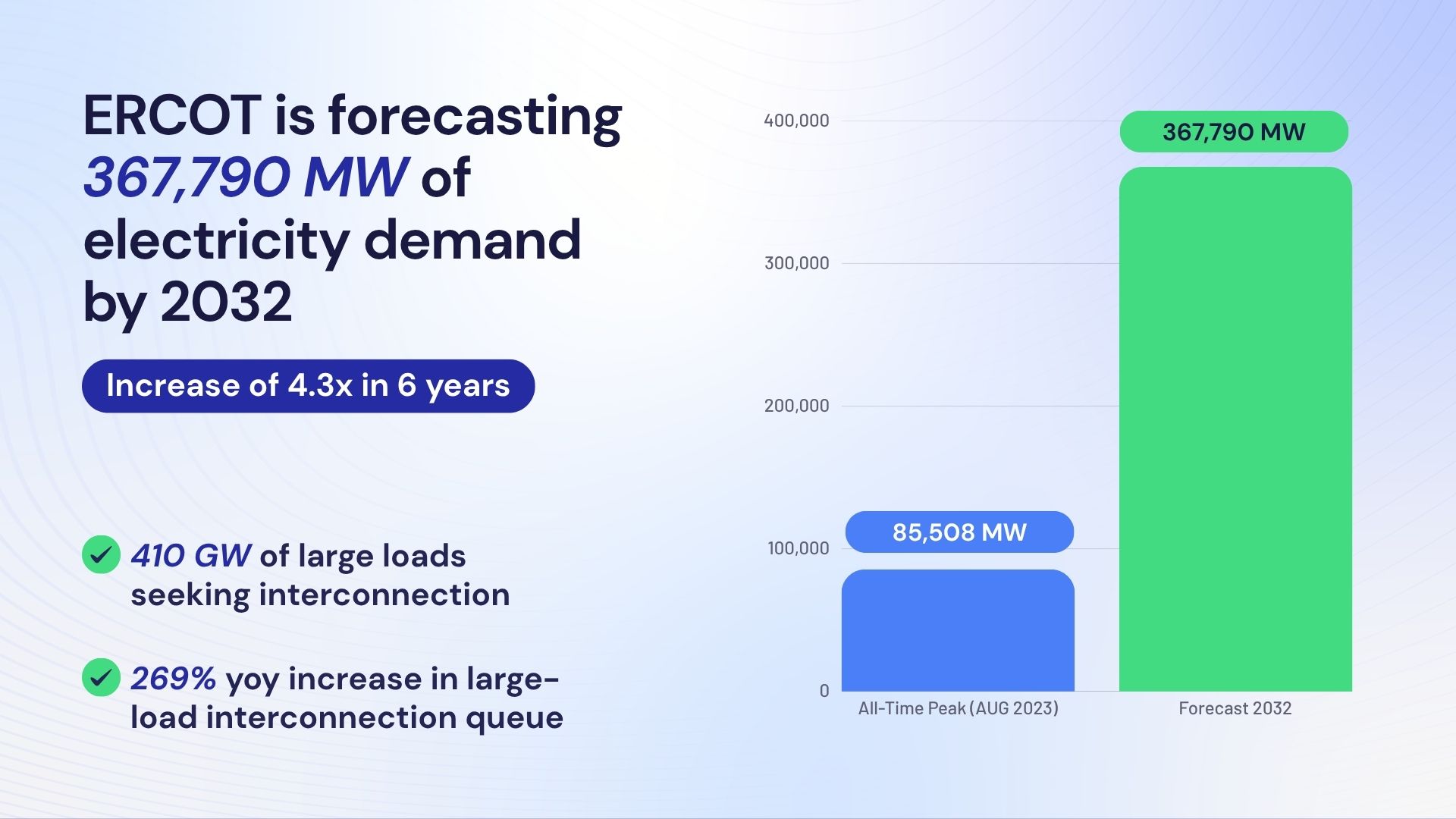
This month, the Electric Reliability Council of Texas filed a preliminary long-term load forecast that turned heads with industry experts and citizens alike. By 2032, ERCOT projects peak demand in Texas could reach 367,790 megawatts—more than four times the all-time record of 85,508 MW set in August of 2023.
Before we panic, let’s add a little context: ERCOT's own CEO, Pablo Vegas, flagged the figure as likely overstated, and the organization marked it preliminary. But even stripping out speculative pipeline submissions, the adjusted forecast still approaches 111,000 MW—a staggering increase that demands serious attention. And more than that, a solution.
The driver of these increases? Data centers, in large part. According to ERCOT's presentation, data centers alone account for over 228,000 MW of submitted large load requests by 2032—more than 60% of the total projected increase. Cryptocurrency mining, industrial growth, oil and gas, and population growth accounts for the rest.
Whether or not the headline number reflects what will actually be built, the directional signal is clear: Texas is on a trajectory of energy demand growth that has no real modern precedent, and grid infrastructure is going to be under sustained, increasing stress in the years ahead. But this isn’t just an issue for future policymakers to solve—it's something we need to start planning for now.
This isn't a future problem. It's a present one.
Texans don't need consumption forecasts to remind them that grid stress feels like. For a lot of families, the devastation of February 2021 and Winter Storm Uri is still fresh in their minds. In Texas, grid instability has become the norm, and regular outages, both short and long, have started to change the way they think about energy reliability day-to-day.
It is worth noting that over the past few years, ERCOT has made real improvements. Investments in weatherization, reserve margins, and renewable generation have helped greatly—but the growth that ERCOT is now formally projecting introduces a different category of challenge. The grid wasn't designed for 367,000 MW. It wasn't even designed for 111,000 MW. And building enough centralized generation and transmission to keep pace with that kind of demand will take years that the market may not have.
The question for homeowners isn't whether the Texas energy grid will face pressure—the question is whether their home will feel that pressure when it does.
Distributed energy isn't just a talking point anymore.
For years, the energy industry has talked about Virtual Power Plants and distributed energy resources as a promising idea—a way to turn home batteries, smart thermostats, and flexible loads into a network that could support grid reliability from the bottom up.
That idea is now a practical imperative.
ERCOT's forecast shows a grid that will increasingly depend on demand flexibility to bridge the gap between supply and peak need. Traditional generation can't be built fast enough. Transmission infrastructure takes years to permit and construct. But a connected network of home batteries—each one storing energy during off-peak hours and contributing back to the grid when stress peaks—can scale in ways that centralized generation simply can't.
This is exactly the model Energywell was built around. When you join our Connected Energy Community, your home battery doesn't just provide backup power for your household—it becomes part of an intelligently managed network that helps balance load across the grid during high-demand periods. The more homes that connect to the network, the more value the system creates for everyone—that's how we're able to install and maintain your battery system at no upfront cost, and how we can offer you a competitive, fixed-rate energy plan designed to stay affordable over time.
The value flows in both directions. Your home gets resilience. The grid gets flexibility. And that exchange is what makes the whole thing work.
What this means for Texas homeowners, practically.
The ERCOT forecast is a planning document. It's not a prediction that the lights will go out in 2027, but it does tell us several things worth taking seriously.
Peak demand events will become more frequent, and the margin between available supply and peak demand narrower than it has been in the past. For Texas homeowners, that means more instances where the grid is under strain, and more instances where backup power goes from a nice-to-have to a genuine necessity.
Energy prices will be more volatile and when demand spikes and supply is constrained, wholesale energy prices spike with it. Texas operates a competitive electricity market, and that's generally a good thing, but it also means that price exposure is real. A fixed-rate plan, protected by a Lowest Rate Guarantee at renewal, is a meaningful hedge against that kind of volatility.
The grid will increasingly rely on distributed resources to keep the lights on. ERCOT is already working on frameworks to better integrate large loads and distributed energy into its planning processes. The direction of travel is clear: homes and businesses that can absorb and return energy intelligently are going to be a critical piece of grid infrastructure going forward.
The smarter grid starts at home.
There's a version of this story that's anxiety inducing—a grid under impossible pressure, demand curves that defy credulity, a state whose energy infrastructure is being asked to do something it was never designed to do.
But there's another version, one where the response to that pressure isn't just a top-down infrastructure buildout, but a ground-up shift in how homes interact with the grid. One where thousands of connected households—each one storing energy intelligently, each one ready to contribute back when it's needed most—become a genuinely meaningful part of the solution.
That's what Energywell is building. A network of homes that are more resilient, more connected, and more capable of navigating whatever the grid throws at them. If ERCOT's forecast tells us anything useful, it's that building that network isn't just a good idea, it's a necessary one.

.png)
.png)