
When the Grid Goes Down in Illinois, a Generator Isn't Your Only Option Anymore
Whole-home battery backup is replacing generators for homeowners seeking easy, automatic, and reliable outage protection.

If you live in Illinois, and most especially near Chicago, you already know the rhythm of this summer. A line of storms rolls in, the sky turns a color you’ve never seen it turn before, and prior to you finishing your dinner, a few hundred thousand homes have lost power. Last week, raging storms and four confirmed tornados left more than half a million ComEd customers measuring their restoration timeline in days rather than hours, and while ComEd called the storms unprecedented, that word would land better if it hadn’t already happened a few times this very summer.
So let's skip the part where we pretend this is unusual. It isn't. The grid isn't struggling to adapt to freak weather; it's buckling under the type of weather Illinois now gets regularly. And if this is the case, it leaves every homeowner with the same quiet question: when the power goes out—not if, but when—how do I keep the lights on? My appliances running? My WiFi working?
For a long time, there was only one answer. Let's start there.
The generator: still works, still asks a lot of you
Give the generator its due. It has historically been there for homeowners across the country during outages, and as long as you can keep feeding it fuel, it runs. But a portable generator only helps if you're home to haul it out and start it. Power fails while you're at work, or asleep, or away for the weekend, and it sits in the garage doing nothing while your freezer quietly defrosts. It runs on fuel you have to store, stabilize, and replace—and fuel is expensive, and can be a hassle to replace when it runs out.
Generators also need maintenance, and we all know they’re loud enough to introduce you to the neighbors you've spent years trying to avoid. They also carry a genuine hazard that safety agencies never stop repeating: generators produce carbon monoxide, so they can never run in a garage or near a window, and people are hurt every year doing it the easy way instead of the safe way.
You can spend your way up to a standby unit that starts on its own—but now you're into permanent installation, an electrician, a fuel line, ongoing service, and a bill that climbs far too quickly for most homeowners to stomach. Either way, the machine asks for the same things: fuel, attention, upkeep, and a high tolerance for noise. A generator doesn't just cost money—it costs your time, it costs attention, and usually asks for both when you’d rather be spending those things elsewhere.
The battery: same job, none of the babysitting
The good news is there’s an alternative, and it isn’t a better generator. It's a different idea altogether—keep the energy at the house, ready and waiting, and take the cumbersome elements that come with a generator out of the equation.
When Energywell installs a system, your home is connected to up to four EcoFlow OCEAN Pro batteries that charge quietly from the grid during lower-cost hours and then simply stand by. The moment grid power drops, your home switches to stored energy in under a hundredth of a second—no can of gas necessary. No trip outside in the rain to yank on a starter, no disrupting your neighbors with noise and chaos. In fact, many of our customers learn there was an outage from a news alert or those same neighbors because for them, there wasn’t so much as a flicker.
The good news? There’s even more good news! Because the battery comes paired with an Energywell electricity plan, the backup isn't a separate purchase you have to talk yourself into. As part of our service, we pair whole-home battery backup with an electricity plan whose rate is guaranteed to beat ComEd's Price to Compare—at least 25% below during the on-peak hours that cover most of the day, and 28% below off-peak—locked in for two years and protected by our Lowest Rate Guarantee at every renewal.
That means you aren’t paying a premium for resilience, but rather you’re getting it as a discount. It’s attached to a rate built to beat the utility's own benchmark—quiet, automatic, and certainly easier than wrestling with a generator in the dark.
So how long will your battery actually run?
This is the question everyone asks, and it deserves an honest answer rather than a number on a brochure. The truth is that it depends, and anyone who hands you a flat "X hours" is selling something. For most homeowners, two things decide how long your battery will last: how full the battery is when the outage starts, and how much your home is pulling while it's out.
The good news is that second part is largely in your hands. Not everything in your house draws power the same way, and the gap between them is enormous.
The breakdown below sorts the usual suspects, and should help you prioritise your usage in case of an outage.
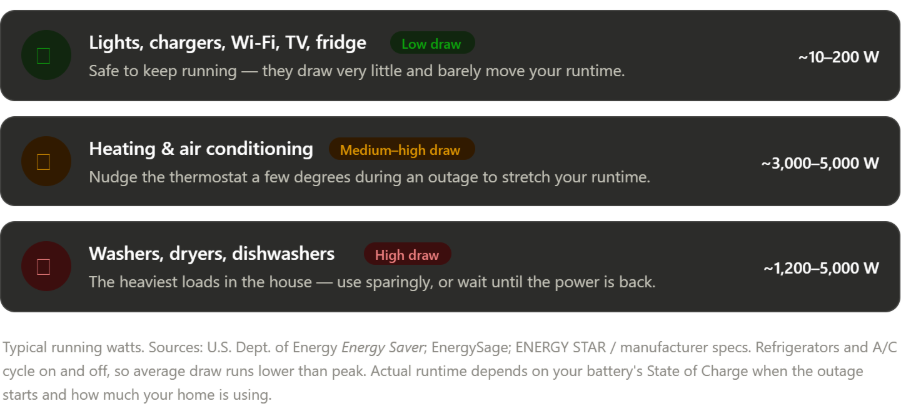
Run the essentials—the fridge, a few lights, the Wi-Fi, phones on the charger, a medical device or two—and a system like this can carry a home through most short-term outages. Fire up the central air, the electric dryer, and the oven at once and you'll drain any battery in a hurry, the same way flooring the gas pedal empties a tank. Ease off the big draws while you're on backup and you'll stretch what you've got considerably.
We won't print a guaranteed runtime on a page, because the honest answer to "how long" is "it depends on the home and the homeowners." What we will tell you is that the system is built to carry a home through the kind of outages Illinois families actually face—the afternoon-into-evening kind that shows up without warning and doesn't care whether you're home to get your generator running.
Power for your home, powerful for your community
One more thing, because it's the part we're not-so-quietly very proud of.
Your battery isn't an island. It's one node in our Connected Energy Community—a network of Energywell homes whose batteries can be coordinated together. During the high-demand stretches that place the most strain on the grid, the batteries in our network can lean in and support the system instead of pulling from it. And while you will never be inconvenienced by this service, it lets you contribute to grid resilience in your community and across Illinois in a pronounced and pretty selfless way.
When you step back and consider, this is a genuinely different model. For more than a century, the grid has been one enormous, centralized river flowing in one direction—from the grid to homes and never backwards. All along we’ve been hoping that it holds, but hope makes for a poor strategy. A distributed web of home batteries changes the game, though—energy stored close to where it's used, spread across thousands of homes instead of concentrated in a handful of aging substations. It makes your home more resilient, it makes the grid around you a little more resilient, and in a state getting hit as often as this one, both of those things matter.
We’ve got your back (up)
If you've spent the last few weeks refreshing the ComEd outage map and shopping for generators while watching gas prices rise, maybe give us a call before you run out and make any purchases. Energywell installs our system for $0 upfront and with no equipment costs, so get in touch and we’ll walk you through how the battery program works for Illinois homeowners, check whether your address and ComEd service area qualify, and lay the whole thing out so you understand exactly what you’re getting and why you’re getting it.
Unlike that generator, we’ll never leave you struggling in the dark.
DISCLOSURE: Backup power duration depends on the battery's charge level at the start of an outage, and the rate of energy consumption during the outage. Higher charge levels and lower usage will result in longer backup duration. Constant backup power not guaranteed for the full duration of every outage. Retail electricity products offered by Fanfare Energy, LLC d/b/a Energywell (Illinois Commerce Commission Docket No. 26-0381). Battery management services offered by Energywell Home, LLC (“EWH”). Fanfare is an independent Alternative Retail Electric Supplier (“ARES”) and is not affiliated with, endorsed by, or acting on behalf of ComEd, any consumer group, or any governmental body or program. You are not required to enroll with Fanfare. Beginning on June 1, 2026, the electric supply price to compare is 10.399 cents per kilowatt-hour. The electric utility electric supply price will expire on September 30, 2026. The utility electric supply price to compare does not include the purchased electricity adjustment factor. For more information go to the Illinois Commerce Commission's free website www.pluginillinois.org. The purchased electricity adjustment factor may range between +.5 cents and -.5 cents per kilowatt hour. Fanfare and EWH offers are not available in all U.S. jurisdictions and may vary or be discontinued at any time.

.png)
.png)